Beauty of the Box Template in CSA Software

The Template Sets the Baseline
Most farmers planning a CSA season face a strange kind of arithmetic problem. There are twenty or more weeks ahead, each one needing its own decision about what goes in the box, and making that decision twenty separate times is exactly the kind of repeated cognitive load that leads to mistakes, inconsistency, or simply not doing it at all until the week arrives and the pressure forces a decision. The box template exists to collapse that problem into a single one.
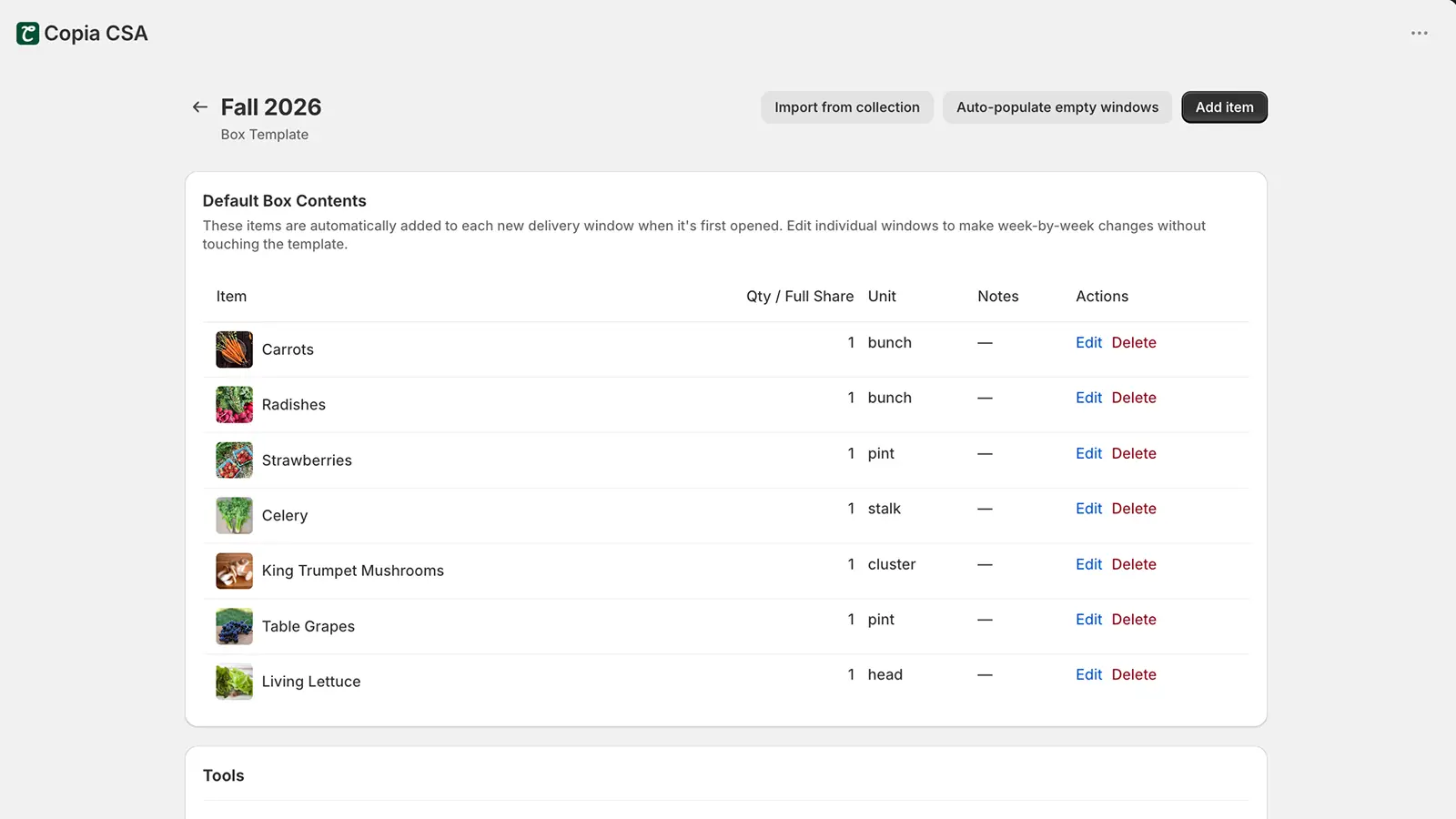
A box template is, at its core, a default: a farmer fills in what a typical week’s box looks like once, and that default gets applied across every pickup and delivery window for the rest of the season. Farmigo popularized this approach inside the CSA software category, and it remains one of the more genuinely useful ideas in the space, precisely because a default is not the same thing as a mandate. The template sets the starting position. It does not lock the farmer into following it.
Planning Once, Adjusting Often
The actual value of a template shows up in what happens after it’s applied. A farmer fills out a season’s worth of boxes in one sitting, in the calm of pre-season planning rather than the scramble of a Tuesday harvest morning, and then spends the rest of the season making small, local adjustments instead of large, repeated ones. Let’s say week six’s lettuce came in early & week eleven needs an extra bunch of basil because the tomatoes are running ahead of schedule… Those are edits to a plan, not a plan built from nothing every single week.
This is a meaningfully different cognitive task than starting from a blank box each time. Editing a known quantity is fast. Generating a new quantity from scratch, week after week, for an entire season, is the kind of task that quietly drains a farmer’s attention away from the harvest itself. The template’s real contribution isn’t the box it produces in week one. It’s the hours of decision-making it removes from weeks two through twenty.
Farmers running CSAs have been talking about the efficiency of the box template model for some time now. Max Becher of First Steps Farm described exactly this on the Farm Small Farm Smart Daily podcast, naming the box template as the single most important feature in how he runs his CSA. Once a season’s worth of boxes is mapped out in advance, the rest of the work becomes adjustment rather than invention, which is precisely the shift that frees up a farmer’s attention for the parts of the season that actually require it.
Where Choice Comes Back In
A template solves the farmer’s problem, but will go unnoticed on the member’s side. Research on CSA retention consistently points to the same complaint from members who don’t renew: not enough say in what they’re getting. A default that the farmer can’t deviate from is efficient for exactly one party in the transaction.
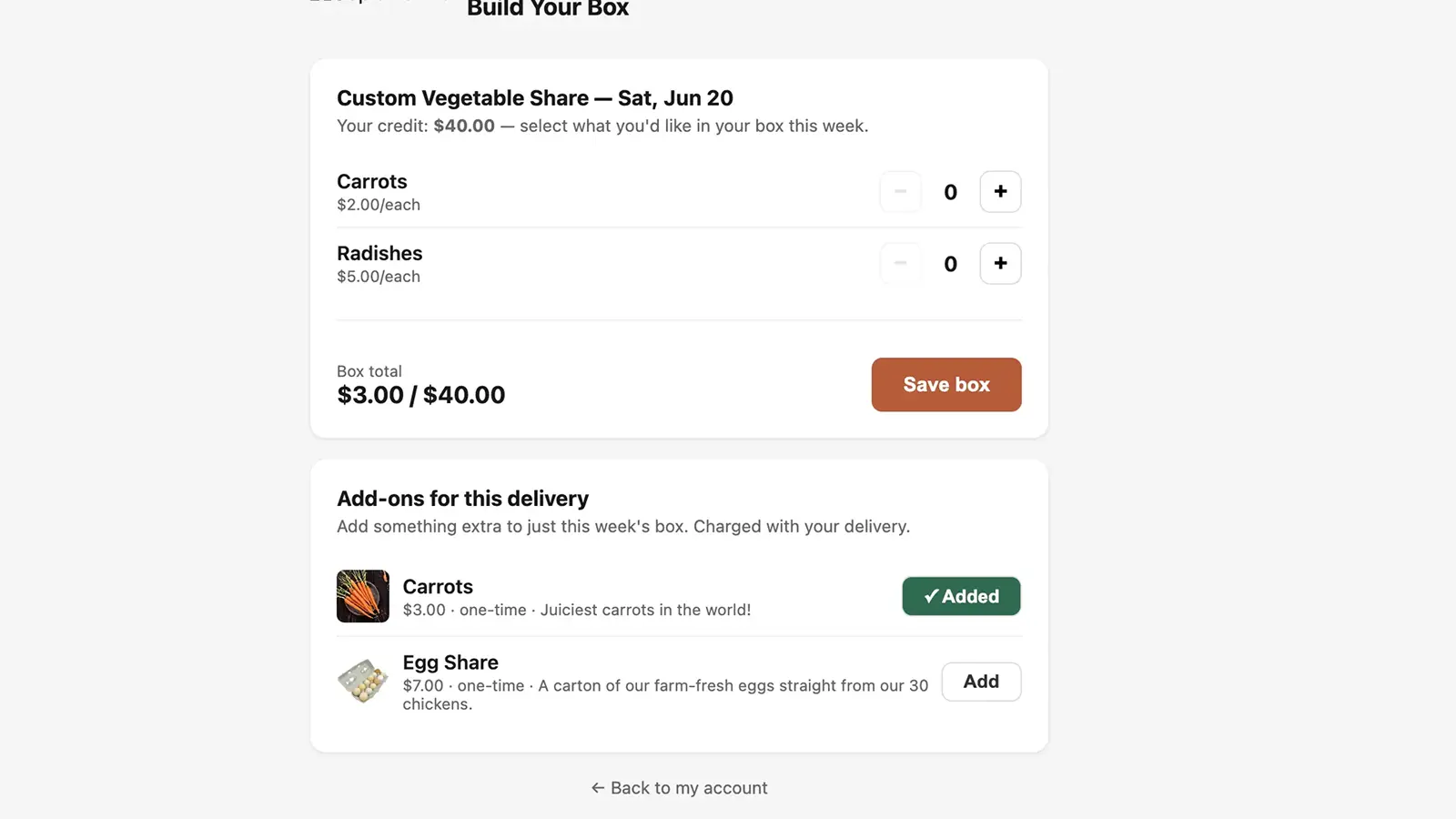
This is where customizable boxes complete the system rather than compete with it. The template still sets the baseline, the farmer’s best read on what a typical week should contain, but a member working from a customizable share can swap items in or out from what’s actually available that week, building something closer to what they actually want to cook with. The farmer isn’t building each member’s box individually from scratch, and the member isn’t stuck accepting whatever the template assigned them. Each layer is doing the part of the job it’s actually good at.
Two Systems, One Box
What makes this combination work is that the template and the customization layer are solving different problems for different people, and neither one is asked to do the other’s job. The template exists so a farmer can plan an entire season’s worth of harvest in an afternoon instead of twenty separate afternoons. The customization layer exists so a member can adjust the result of that planning to fit their own kitchen, without either side needing to coordinate with the other in real time.
That’s the part that’s easy to miss when a box template gets dismissed as a minor convenience feature. It isn’t competing with member choice. Instead, it’s the only reason member choice is operationally possible for farms looking to scale. A farm packing thirty boxes a week can absorb some manual customization, but a farm packing three hundred cannot, unless the starting point for every box is already mostly decided.
Copia builds the box template and harvest planning around exactly this relationship: a season-long template a farmer sets once, week-by-week harvest planning for the adjustments that inevitably come up, and a member-facing box builder for farms that want to offer real customization without rebuilding every box from nothing. The result is a system where planning a season and giving members a say in their box aren’t competing goals. They’re the same workflow, looked at from two different sides of the same Shopify store.
Copia is a growth platform for modern CSA farms. Based in San Diego, CA, they specialize in all things direct-to-consumer for small and mid-sized farms. Copia is not only software, but a suite of services for farms, including website design and development, digital marketing strategy, and more. For inquiries, contact [email protected].
Want to learn more about Copia?
See if our tools can help your farm grow on Shopify. $29/mo locked forever.
View Features